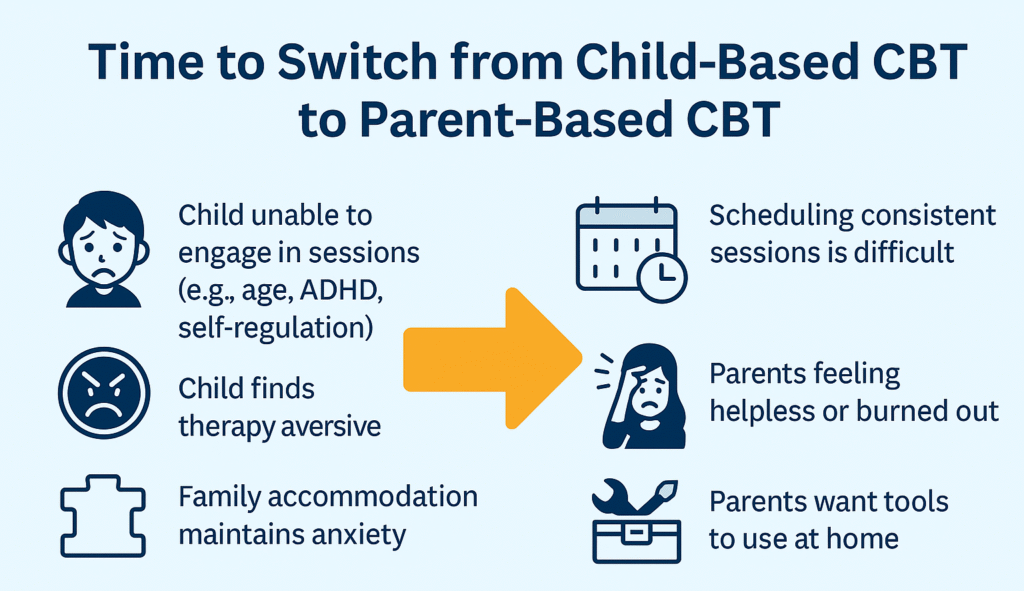
Because Helping Your Child Starts with Supporting You
At Light On Anxiety, we believe parents deserve the same care and evidence-based tools we give to children. Our Parent-Based CBT for Child Anxiety Services are designed to help you better understand your child’s anxiety, guide them through it effectively, and find your own sense of calm and confidence along the way.
When a child struggles with anxiety, the whole family feels it.
Parent-Based CBT (Cognitive Behavioral Therapy) is an evidence-based approach that helps parents learn tools to actively support their child’s recovery, even when the child isn’t ready or willing to participate in therapy.
At Light On Anxiety, we empower parents to become agents of change — learning how to respond to anxiety in ways that reduce distress and build confidence for both child and parent.
Parent-Based CBT focuses on teaching parents to:
Reduce accommodation — stop the rescue patterns that unintentionally make anxiety stronger.
Model calm and confidence — help your child’s brain learn safety through your example.
Strengthen connection — use warmth and positive attention to rebuild trust and cooperation.
Reinforce bravery — reward effort and progress, not avoidance.
Stay consistent — provide calm, predictable structure that reduces family stress.
Regulate your own emotions — learn tools to manage your own anxiety and respond mindfully.
Through this process, parents discover that small changes in their responses can lead to big improvements in their child’s anxiety and overall family functioning.


Dozens of studies have found that parent-delivered CBT can be just as effective as traditional child-based CBT for anxiety.
Even when the child does not participate directly in therapy, anxiety symptoms often improve as parents learn new ways to respond.
Parent-Based CBT has been shown to:
Reduce anxiety, avoidance, and reassurance-seeking in children
Increase bravery and independence
Improve emotional regulation and family communication
Decrease parental guilt, stress, and helplessness
In other words, helping parents heal helps children heal — because kids learn regulation and resilience through their parents’ calm and confidence.

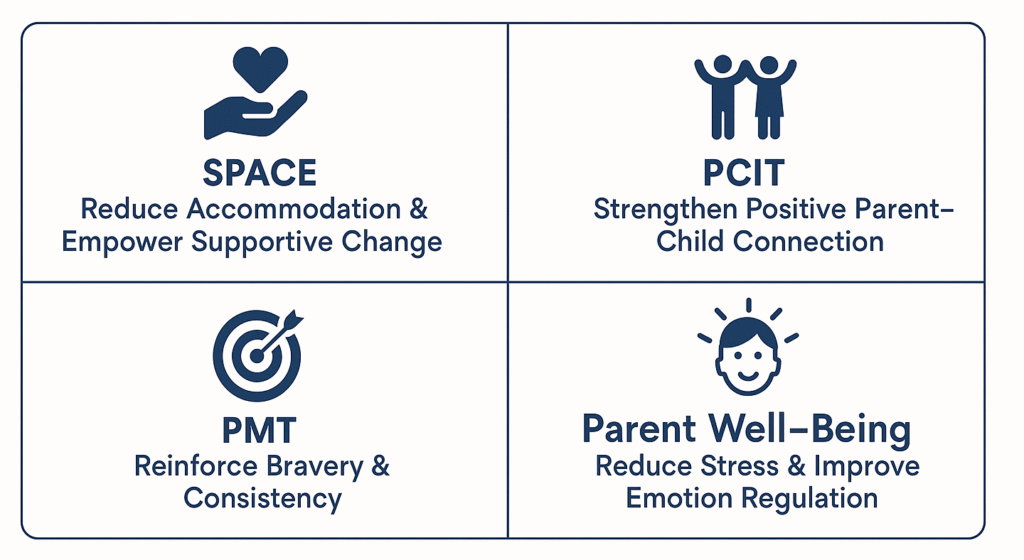
Our approach combines the best of four research-supported models:
SPACE – Reducing accommodation and empowering supportive change
PCIT – Strengthening positive parent–child connection
PMT – Reinforcing bravery and consistency
Parent Well-Being – Helping parents manage anxiety, stress, and emotional regulation
At Light On Anxiety, we believe in family healing from the outside in — because when parents feel calmer and more confident, their child learns that bravery is possible.

Do you worry about your child all the time? Maybe they are behind on certain milestones, struggling in school, having difficulty making friends, or heading off to college and away from home for the first time. Their problems or struggles become your own, and you end up feeling so anxious that you forget what it’s like to just enjoy being their parent. The good news is that you can rewire your “parent brain” to respond differently to these challenges. This book will show you how to replace parental anxiety with parental effectiveness.
In Overcoming Parental Anxiety: Rewire Your Brain to Worry Less and Enjoy Parenting More, three anxiety specialists team up to help you change your anxious brain using the core principles of neuroscience and exercises from Cognitive Behavioral Therapy (CBT) and mindfulness.
Dr Kissen is a clinical psychologist who is the CEO of Light On Anxiety Treatment Centers. Edward Plimpton, Ph.D talks with her about her recent book on using cognitive behavior therapy to help with parental anxiety.
We are honored to assist you in your journey through Parent Coaching!
Parent-Based CBT is a service that helps parents understand and apply cognitive-behavioral therapy (CBT) principles to support their children who are struggling with anxiety. It provides parents with strategies and tools to manage their children’s anxiety and improve family dynamics.
Parents of children and teenagers experiencing anxiety, OCD, or related disorders can benefit from this service. It is also helpful for parents seeking to improve their parenting skills and create a supportive home environment.
During a session, you will work with a trained therapist to discuss your child’s specific challenges, learn CBT techniques to address these issues, and develop practical strategies to support your child’s emotional well-being. Sessions are tailored to meet the unique needs of each family.
The duration of parent coaching varies depending on the individual needs of the family. Some families may benefit from a few sessions, while others might engage in coaching over several months to address more complex issues.
Parent-Based CBT focuses specifically on empowering parents with CBT strategies to help their children manage anxiety. Unlike traditional therapy, which often involves direct work with the child, this coaching involves educating and training parents to implement CBT techniques, in order to create change from the outside in.
Benefits include learning effective strategies to manage your child’s anxiety, improving your parenting skills, enhancing family communication, reducing parental stress, and fostering a supportive home environment that promotes your child’s emotional health.
While the primary focus is on coaching parents, there may be instances where involving the child in some sessions can be beneficial. This decision will be made collaboratively between you and your therapist based on your family’s specific needs.
To get started, you can contact our clinic to schedule an initial consultation. Our intake team will guide you through the process, answer any questions, and match you with a therapist who best meets your needs.
When parenthood calls for jam-packed agendas, racing thoughts, and multitasking, mindful parenting allows for increased connection, fulfillment, and joy in the present with your child and family. Take a moment to complete the following 2 part exercise and really notice the difference in your experiences.

Compare and contrast these two experiences.
After you try the above exercise, ask your child to guess which mental state (mindless or mindful) was which.
Next, reverse roles and have your child be the listener and you be the speaker. Have them either mindfully or mindlessly attend to you and then you guess which mental state was which. Together, discuss how it felt to be on the receiving end of mindful vs. mindless attention and how it felt to be the one providing either mindful or mindless attention.
Book a time at a Light On Anxiety location or schedule a virtual session.