
A simple way to turn tense tables into moments of connection.
Holiday family meals are wonderful… until they aren’t.
It only takes a few minutes around the table for familiar patterns to kick in: old roles, political opinions, ancient sibling rivalries, or simply the unique crankiness that comes from too many people, too many errands, and not enough calm.
And because winter holidays compress everyone’s emotions — joy, nostalgia, stress, exhaustion — the tone at the table can shift quickly.
That’s where a little structure can work magic.
Not therapy.
Not forced gratitude.
Just a few light, playful conversation prompts that help families connect with who each person is today, instead of getting swept back into who everyone used to be.
This toolkit gives families a way to keep meals warm, safe, and even fun — without trying to manage or control the conversation.
Why Unstructured Conversation Can Go Off the Rails
(Especially During the Holidays)
When a group gathers without any conversational anchor, the brain does what brains do under stress: it defaults to the familiar.
For families, that often means:
• political landmines
• rehashing old stories that hit raw spots
• anxious small talk
• interrogations masked as “curiosity”
• criticism disguised as “helpfulness”
• children melting down from sensory overload
• adults melting down from emotional overload
• hanger and fatigue taking the wheel
Unstructured conversation creates space for old dynamics to take over — not because anyone is bad, but because this is how the brain protects itself in tense environments.
A tiny bit of structure isn’t controlling.
It’s regulating.
How a Small Prompt Sheet Can Rewire the Room
A conversation tool does three things:
1. Interrupts unhelpful patterns
It creates a gentle pause between impulse and action, giving everyone a chance to choose connection over reactivity.
2. Invites curiosity instead of friction
Prompts guide people toward the present — what they’re learning, enjoying, or noticing — instead of rehashing the past.
3. Helps the group “reset” together
Just one structured moment can re-anchor the entire table.
It sends a message: This meal is about knowing one another, not navigating landmines.
Families don’t need a full reboot — they just need a cue.
A Real-Life Example: How I Used This at Thanksgiving
To test this idea, I created a simple one-page Thanksgiving tool called Turkey Talk — an illustrated sheet with gentle, humorous prompts designed to invite sharing without triggering emotional intensity.
I placed it in the middle of the table and said:
“Let’s each pick one prompt to answer — serious or silly.”
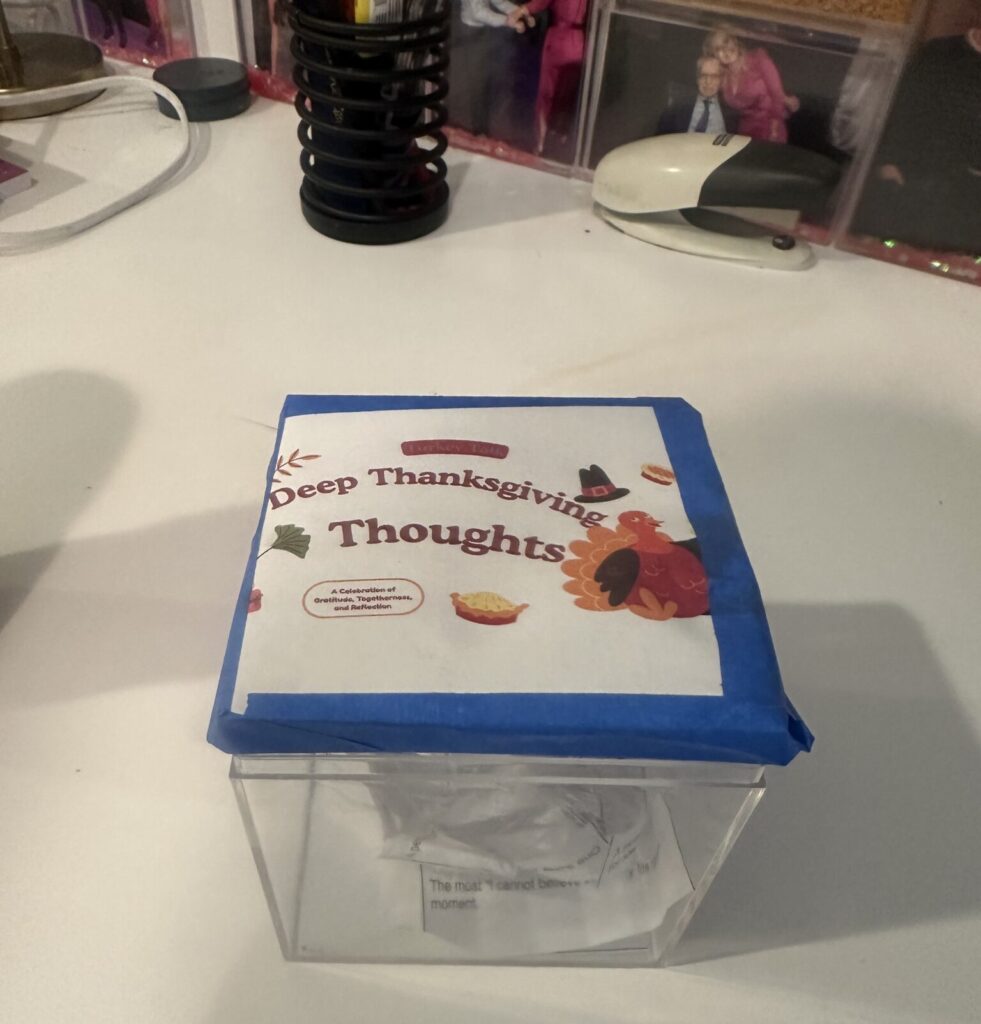
And it worked because:
• it was optional
• it was light
• it was welcoming to every age
• it pulled the focus into the “here and now”
• it nudged the group out of old grooves
Here is the Thanksgiving version I made: Turkey Talk.
I’ve also created general versions that work for any holiday meal — Christmas, Hanukkah, New Year’s, or simply a long family weekend.
Download Your Holiday Family Meal Survival Toolkit
Below are two simple, holiday-neutral tools you can print and place right on your table:
Holiday Table Talk Sheet
A warm, easy set of prompts that help guide conversation back to connection, curiosity, and shared presence:
Holiday_Table_Talk_Sheet.
60-Second Group Reset Card
A tiny structured pause you can use when the energy starts to drift into stress or tension:
60_Second_Family Meal_Reset_Card.
These tools are quick, optional, and designed to help everyone at the table take a breath and come back to the moment.
You & Your Family Deserve Less Stressful/More Joyful Holiday Meals
Family meals can be a place where old patterns rush in… or a place to slowly rewrite what it feels like to sit together.
A small prompt sheet won’t make a family perfect.
But it can spark:
• a safer emotional atmosphere
• a healthier rhythm
• moments of real warmth
• a gentle reset when things get tense
• a chance to see each other as we are now — not who we were at age 8
• new micro-memories of connection
This is the real value of structured conversation:
It doesn’t force closeness.
It simply creates a space where closeness has room to grow.
