
If you’ve ever caught yourself spending too much time re-reading an email before hitting send, tweaking a project long past “done,” or getting stuck on the fear of making a mistake — you’re not alone.
Perfectionism is sneaky. It can look like high standards, dedication, or attention to detail — but underneath, it’s often driven by anxiety. The belief that if I get it just right, I’ll finally feel calm or safe.
The problem? That calm never lasts. The bar keeps moving higher, and the self-criticism gets louder.
At Light On Anxiety, we see perfectionism as a close cousin of anxiety: it’s your brain’s way of trying to stay safe by avoiding criticism, failure, or discomfort. But safety doesn’t equal peace — it just keeps you stuck in the exhausting loop of over-checking, over-fixing, and never-enough-ness.
The Real-World Impact of Perfectionism
Perfectionism can quietly create ripple effects in every area of life:
Emotionally – Increases anxiety, self-criticism, shame, and burnout.
Cognitively – Fuels all-or-nothing thinking and fear of failure.
Behaviorally – Leads to procrastination, overworking, or avoidance.
Relationally – Creates tension through control, defensiveness, or over-apologizing.
Physically – Keeps your body in a chronic stress state, impacting sleep, energy, and immunity.
Is Perfectionism Holding You Back?
A Self-Assessment of the Hidden Costs
Perfectionism might sound like a positive trait — who doesn’t want to do things well?
But when “doing your best” turns into “never good enough,” it can quietly chip away at confidence, energy, and relationships.
Take a moment to reflect on how perfectionism shows up in your life.
Read each statement below and rate how true it feels for you:
0 = Not at all true | 1 = Sometimes true | 2 = Often true | 3 = Almost always true
| # | Statement | 0 | 1 | 2 | 3 |
|---|---|---|---|---|---|
| 1 | I feel anxious or guilty if I make a mistake. | ||||
| 2 | I spend excessive time double-checking or re-doing tasks. | ||||
| 3 | I struggle to start tasks unless I feel completely prepared. | ||||
| 4 | I focus more on what went wrong than what went right. | ||||
| 5 | I avoid situations where I might not excel. | ||||
| 6 | I have difficulty delegating because others won’t do it “right.” | ||||
| 7 | Small errors feel like big failures. | ||||
| 8 | My self-worth depends heavily on achievement or productivity. | ||||
| 9 | I rarely feel satisfied with my performance, no matter how well I do. | ||||
| 10 | I feel tense or on edge when things are not “just right.” |
Scoring:
- 0–9: You may hold healthy standards without significant cost.
- 10–18: Some perfectionistic tendencies — worth watching how they affect stress or enjoyment.
- 19–30: Perfectionism is likely interfering with peace, productivity, or relationships. Consider practicing daily “good enough” exposures or exploring CBT tools for flexibility.
But here’s the good news: perfectionism is learned, and that means it can be unlearned.
Through CBT and exposure exercises, you can teach your brain that imperfect is not only safe — it’s human, and often the most direct route to growth and calm.
So here’s your daily challenge:
Let today be imperfect — on purpose.
Just like brushing your teeth or taking a vitamin, practice doing one small daily “exposure” to being good enough instead of perfect. Each small act helps retrain your brain to tolerate mistakes, build flexibility, and reclaim the joy in being human.
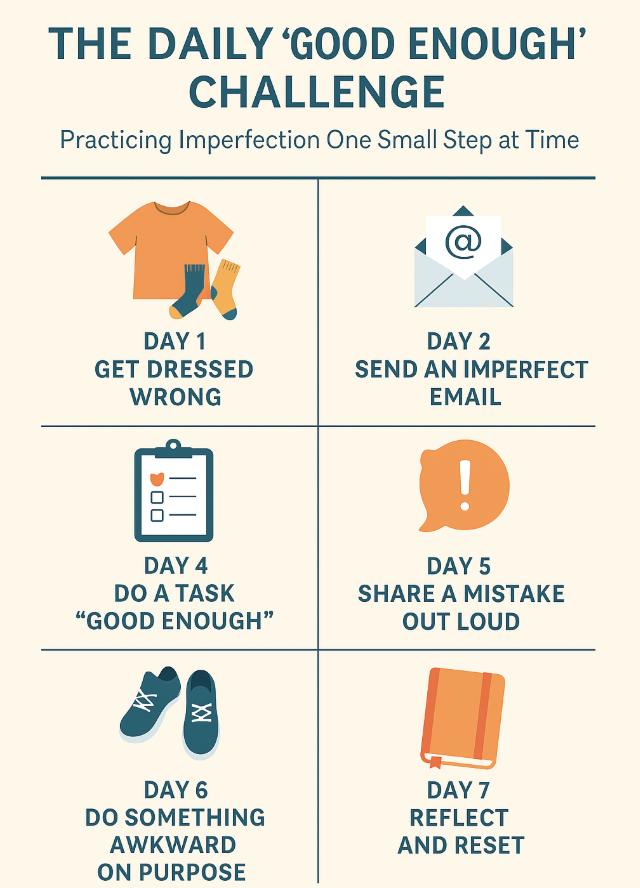
The Daily “Good Enough” Ritual
Try one of these mini-experiments each day this week.
Day 1: Get Dressed Wrong
Put your shirt on before your pants, or wear mismatched socks. Feel the urge to “fix it,” and remind yourself — the goal isn’t to look perfect, it’s to practice calm in imperfection.
Day 2: Send an Imperfect Email
Write your email, give it a quick glance, and hit send — even if there’s an extra space or a minor typo. Then notice: did anything bad actually happen?
Day 3: Do a Task “Good Enough”
Make the bed loosely. Cook without measuring. Let your to-do list have unchecked boxes. The world will keep spinning — and you’ll prove to yourself that effort, not perfection, is what counts.
Day 4: Prioritize, Don’t Perfect
Pick one area to give your full attention today, and intentionally let other tasks be “fine for now.” You’ll build tolerance for imperfection while reclaiming energy and focus.
Day 5: Share a Mistake Out Loud
Tell a friend or coworker, “I messed up a small thing today.” Watch how they respond — probably with empathy, not judgment. Vulnerability often invites connection, not rejection.
Day 6: Do Something Awkward on Purpose
Try your non-dominant hand in tennis, dance badly to your favorite song, or sing off-key in the car. You’ll practice finding joy in imperfection — and maybe even laugh along the way.
Day 7: Reflect and Reset
Ask yourself:
- What went “wrong” this week — and how did I handle it?
- What did I learn about my perfectionism voice?
- What do I want to keep practicing next week?

Why This Works
Each daily “imperfection exposure” teaches your brain a new rule: mistakes are safe.
The more often you let yourself be human — messy, late, uneven, real — the quieter your inner critic becomeFinal Thought
Perfectionism tells you that your worth is conditional — that peace comes after everything is “just right.”
But peace actually begins the moment you say, “I’m good enough right now.”
So start small. Miss a comma. Wear mismatched socks. Let your email have one extra space.
You might just find that imperfection is where life gets a little more fun.
