
Exposure therapy is often associated with treating fears, phobias, and obsessive-compulsive disorder. But exposure-based approaches are also among the most effective treatments for post-traumatic stress disorder, or PTSD.
That can initially feel confusing.
If someone has experienced a genuinely frightening or painful event, why would therapy ask them to think about it, talk about it, or approach reminders of it? Shouldn’t trauma be handled as gently and carefully as possible?
Trauma should always be treated with compassion, respect, and clinical care. But being careful does not necessarily mean avoiding anything that brings up distress.
In fact, avoiding traumatic memories and reminders can keep the brain’s danger alarm activated long after the actual danger has passed.
Exposure therapy for OCD and PTSD looks different, but both treatments help people learn an important lesson:
Feeling anxious, distressed, or uncomfortable does not always mean that you are currently unsafe.
What Is Exposure Therapy?
Exposure therapy helps people gradually approach thoughts, memories, feelings, sensations, situations, or objects they have been avoiding.
The goal is not to force someone into overwhelming distress. It is also not simply to make someone anxious until the anxiety disappears.
The goal is to help the brain develop new learning.
Through repeated, intentional practice, a person may discover:
- “I can handle this feeling without escaping.”
- “A thought is not the same as an action.”
- “Remembering the event is not the same as reliving it.”
- “This situation reminds me of danger, but I am not in danger right now.”
- “I can feel uncertain without needing complete reassurance.”
- “I am stronger and more capable than my anxiety has led me to believe.”
Exposure therapy is always intended to be collaborative. You should understand why an exercise is being recommended, what it is designed to help you learn, and how your therapist will support you through it.
How Exposure Therapy Helps OCD
OCD often begins with an unwanted thought, image, feeling, sensation, or doubt.
For example:
- “What if I accidentally hurt someone?”
- “What if I am contaminated?”
- “What if I made a terrible mistake?”
- “What if this thought says something bad about me?”
- “What if I never feel completely certain?”
These thoughts can create intense anxiety, guilt, disgust, or uncertainty. To feel better, a person may perform a compulsion.
Compulsions can include:
- Checking
- Washing or cleaning
- Repeating actions
- Asking for reassurance
- Avoiding certain people or situations
- Reviewing past events
- Confessing
- Searching online
- Mentally arguing with or neutralizing thoughts
Compulsions may reduce anxiety temporarily. Unfortunately, that relief teaches the brain that the compulsion was necessary.
The next time the thought appears, the urge to perform the compulsion becomes even stronger.
Exposure and response prevention, commonly called ERP, helps interrupt this cycle.
During ERP, a person gradually approaches an OCD trigger while practicing not performing the usual compulsion.
For example, someone with contamination OCD may touch a public surface and delay washing their hands. Someone with harm OCD may allow an upsetting thought to be present without analyzing it, seeking reassurance, or trying to prove that they are a good person.
The goal is not to prove that nothing bad could ever happen.
Instead, the person practices learning:
“I can tolerate uncertainty and continue living my life without completing this ritual.”
How Exposure Therapy Helps PTSD
PTSD can develop after someone experiences or witnesses a traumatic event.
Symptoms may include:
- Unwanted memories or nightmares
- Flashbacks
- Feeling constantly on guard
- Avoiding people, places, activities, or conversations
- Feeling numb or disconnected
- Intense guilt, shame, fear, or anger
- Difficulty sleeping
- Feeling as though the event could happen again at any moment
After trauma, the brain may begin responding to reminders of the event as though the danger is still happening.
A car accident survivor may avoid driving. Someone who experienced an assault may avoid being alone, entering certain places, or sitting with their back to a door. Someone who experienced a frightening medical event may avoid doctors, hospitals, or physical sensations that remind them of what happened.
These reactions make sense. The brain is trying to protect the person from ever experiencing the same danger again.
But when avoidance spreads, a person’s life can become increasingly restricted.
Exposure-based PTSD treatment helps the brain learn to separate past danger from present safety.
What Does PTSD Exposure Involve?
PTSD treatment may involve approaching the memory of the trauma as well as safe reminders that have become associated with it.
Revisiting the traumatic memory
A therapist may help the person intentionally talk through or imagine the traumatic event in a safe and structured setting.
This may sound similar to a flashback, but it is actually quite different.
A flashback feels involuntary and out of control. Therapeutically revisiting a memory is planned, supported, and experienced while remaining connected to the present.
Over time, the person may begin to learn:
- “This memory is painful, but it cannot physically harm me.”
- “I am remembering what happened then while remaining safe now.”
- “I do not need to spend my life running from this memory.”
- “I can feel grief, fear, anger, or shame without being consumed by it.”
The treatment does not erase the event or make it acceptable. It helps the memory become something that happened in the past rather than an alarm that continues to signal immediate danger.
Approaching safe reminders
PTSD treatment may also involve gradually returning to situations that are safe but have been avoided because they remind the person of the trauma.
Examples may include:
- Driving after a car accident
- Returning to a medical setting
- Sleeping without repeatedly checking the locks
- Entering a neighborhood connected to the event
- Sitting in a restaurant without constantly watching the door
- Being home alone
- Having a difficult but important conversation
- Allowing physical sensations of anxiety without immediately leaving
Exposure should never involve placing someone in genuine danger.
The focus is on approaching situations that are reasonably safe but have come to feel dangerous because of their association with the trauma.
How Are OCD and PTSD Exposure Similar?
OCD and PTSD are different conditions, but avoidance plays a major role in both.
When someone avoids a trigger or escapes as soon as distress appears, the brain may conclude:
“I was only safe because I avoided it.”
This prevents the brain from discovering that the person may have been able to handle the experience without escaping.
In both OCD and PTSD treatment, people practice staying present long enough for new learning to occur.
That learning may not be:
- “Nothing bad will ever happen.”
- “I will never feel anxious again.”
- “The trauma was not serious.”
- “I should not be upset.”
Instead, the learning may be:
- “I can tolerate difficult emotions.”
- “I do not have to obey every alarm my brain sends me.”
- “I can choose my actions even when I feel afraid.”
- “I can build a meaningful life without waiting to feel completely safe.”
How Are the Treatments Different?
The most important difference is that OCD usually focuses on a feared possibility, while PTSD involves something painful or frightening that actually happened.
Someone with OCD may fear:
- “What if I hurt someone?”
- “What if I become sick?”
- “What if I made a mistake?”
Someone with PTSD may be thinking:
- “I was hurt.”
- “I was in danger.”
- “Something terrible did happen.”
A trauma therapist should never treat a real traumatic event as though it was simply an irrational fear.
The message is not:
“You were never in danger.”
The message is:
“You were in danger then. Your brain is still reacting as though you are in that event now. We are helping it recognize that the event is no longer happening.”
PTSD treatment may also involve more work related to grief, trust, shame, betrayal, anger, loss, or changes in how someone sees themselves and the world.
Exposure is not the only part of trauma treatment. But it can help people approach the emotions and memories they need to process instead of remaining trapped in avoidance.
Does Exposure Therapy Mean Talking About Every Detail?
No.
Good trauma treatment is not about forcing someone to disclose every detail of what happened. It is also not about repeatedly discussing trauma without a clear therapeutic reason.
Treatment should be purposeful.
Your therapist should be able to explain:
- What you are being asked to approach
- Why it may help
- What pattern of avoidance it is targeting
- What you may learn from the exercise
- How the pace will be adjusted when appropriate
You should also be part of the decision-making process.
Collaboration does not mean you must feel completely ready or completely calm before beginning. Many people feel nervous or uncertain about exposure therapy.
It means that you understand the plan, have the opportunity to ask questions, and are treated as an active participant rather than having treatment done to you.
Is It Harmful to Feel Distressed During Therapy?
Not necessarily.
Exposure therapy can bring up anxiety, sadness, grief, guilt, disgust, anger, or shame. Feeling distressed during a difficult conversation or exercise does not automatically mean that the treatment is harmful.
There is an important difference between distress and danger.
A person can feel extremely uncomfortable while still being physically and emotionally capable of remaining present.
This does not mean therapists should ignore signs that someone is overwhelmed. A trained therapist should assess safety, monitor how the person is responding, and make thoughtful decisions about pacing.
But stopping every time distress appears can accidentally teach:
“These feelings are too dangerous for me to experience.”
A more helpful message is:
“This is difficult, and you do not have to face it alone. You are also capable of learning how to move through difficult emotions without always needing to escape.”
Trauma-Informed Does Not Mean Avoiding Trauma
The phrase trauma-informed care is sometimes misunderstood to mean that treatment should never activate difficult memories or feelings.
Trauma-informed care actually means that treatment is provided with:
- Respect
- Transparency
- Collaboration
- Compassion
- Attention to safety
- Sensitivity to the person’s history
- Support for choice and autonomy
It does not mean assuming that trauma survivors are too fragile to discuss or approach what happened.
Constantly protecting someone from any reminder of the trauma can unintentionally reinforce the belief that the memory remains too dangerous to face.
Effective trauma treatment communicates:
- “What happened to you matters.”
- “Your reactions make sense.”
- “We will not place you in actual danger.”
- “You will have a voice in your treatment.”
- “We also believe you are capable of approaching difficult memories and rebuilding your life.”
What About Exposure Therapy for Children and Teens?
Exposure-based treatment can also be helpful for children and teenagers with OCD or PTSD.
Treatment should always be adjusted to the child’s:
- Age
- Developmental level
- Ability to understand the treatment
- Current living situation
- Family support
- Emotional and physical safety
Children may cry, become anxious, feel angry, or say that they want to stop during an exposure exercise. These reactions should be met with validation and support.
However, distress does not always mean that the exercise is harmful or inappropriate.
A therapist may say:
“Of course this feels hard. Your brain is trying to protect you. We are helping it learn that you are safe now and that you can handle remembering this while staying here with me.”
Parents and caregivers may also need support managing their own emotions.
It is natural to want to immediately remove a child’s distress. But repeatedly helping a child avoid every difficult memory, feeling, or reminder may strengthen the child’s belief that they cannot cope.
The goal is not to force children to “tough it out.”
It is to help them experience difficult feelings while surrounded by calm, supportive adults who communicate:
“You are safe. Feelings can be intense without being dangerous. We believe you can do hard things, and we will stay with you while you do them.”
When Might Exposure Therapy Need to Wait?
Exposure therapy may not be the right immediate step when someone is currently unsafe or unable to meaningfully participate.
Additional support, assessment, or a higher level of care may be necessary when there is:
- Ongoing abuse or danger
- Immediate risk of suicide or serious self-harm
- Severe substance use that interferes with treatment
- Uncontrolled psychosis or mania
- Significant medical instability
- Severe dissociation that makes it difficult to remain connected to the present
- Uncertainty about the correct diagnosis or treatment approach
It is also important to work with a therapist who has specific training in treating OCD or trauma. Not every form of talk therapy includes effective exposure-based treatment.
How Do I Know Whether I Need OCD or PTSD Treatment?
OCD and PTSD can sometimes look similar.
Both conditions may involve:
- Intrusive thoughts or images
- Avoidance
- Reassurance seeking
- Checking
- Feeling unsafe
- Difficulty tolerating uncertainty
- Strong physical reactions
- Replaying events mentally
Some people also experience both OCD and PTSD.
A careful assessment can help determine what is driving the symptoms and which treatment strategies are most appropriate.
For example, repeatedly reviewing a past event could be an attempt to process a traumatic memory. It could also be an OCD compulsion aimed at obtaining certainty about what happened or what it means.
Because the treatments are not identical, identifying the function of the behavior is important.
The Bottom Line
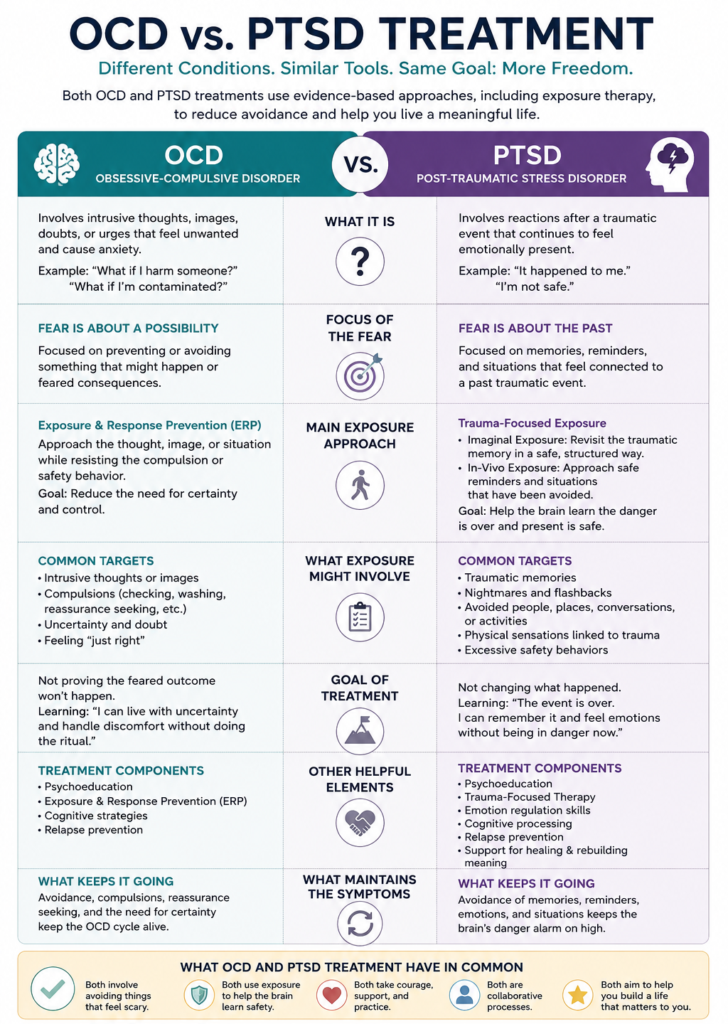
Exposure therapy for OCD and PTSD is not exactly the same.
OCD treatment generally helps people approach intrusive thoughts and uncertainty without completing compulsions.
PTSD treatment helps people approach traumatic memories and safe reminders so the brain can learn that the traumatic event is no longer happening.
Both treatments challenge the idea that the only way to feel safe is to avoid, escape, control, check, or seek reassurance.
Healing does not require forgetting what happened, eliminating every unwanted thought, or never feeling anxious again.
It means learning:
“I can experience difficult thoughts, memories, and emotions without allowing them to determine the size of my life.”
At Light On Anxiety, our goal is not to push people recklessly into distress or protect them from every uncomfortable feeling.
We help clients approach difficult experiences thoughtfully, gradually, and purposefully—so they can spend less energy avoiding fear and more energy building the life they want to live.
