
Social phobia, also known as social anxiety disorder, centers on one core fear: the fear of being judged. People with social anxiety often assume others are evaluating them, noticing their flaws, or deciding something negative about them. The body reacts as if these judgments are catastrophic — as if one mistake could lead to rejection.
Why Your Brain Does This
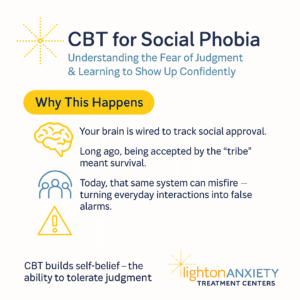
There is a part of your brain designed to keep you attuned to social rules and norms. Historically, belonging to the group meant survival. Losing social standing could mean being pushed out of the tribe and left to fend for yourself. So the brain developed a sensitive system to monitor how others might be perceiving you.
In modern life, this system is still active. It can be helpful in many ways: it nudges you to be considerate, follow norms, and stay connected. But when social anxiety takes over, this same system misfires. It sends a false alarm, treating everyday interactions as if they carry life-or-death consequences.
Confidence vs. Belief in Yourself

A key shift in CBT for social phobia is learning the difference between confidence and belief in yourself. Confidence says, “No one will judge me.” Belief in yourself says, “Even if people do judge me, I will be okay.”
Social anxiety tries to solve the problem by aiming for total elimination of judgment. But that’s not realistic. People will sometimes misunderstand you, dislike something you say, or make their own assumptions. CBT helps you build the internal strength to face these possibilities without shrinking your life.
A Case Example
Meet Maya. She wants to contribute more during work meetings but stays silent because she worries her ideas aren’t good enough. If she feels a moment of hesitation or sees someone glance at their phone, she automatically assumes she has done something wrong. Maya starts avoiding social lunches and stops applying for opportunities that require speaking.
In CBT, Maya learns to notice the alarm going off inside her. She begins to understand that her fear is not a sign of danger — it’s her brain trying too hard to protect her. Treatment helps her practice showing up even when her anxiety tells her she can’t. Over time, she starts raising her hand, tolerating the discomfort, and discovering that even when someone does disagree or look disinterested, she can handle it.
What CBT Treatment Looks Like

CBT teaches new ways to relate to anxiety and to the possibility of judgment:
-
Understanding the false alarms
Clients learn how their brain’s social survival system works and why it sometimes overreacts. -
Noticing and questioning anxious predictions
Instead of automatically believing “They think I’m awkward,” clients practice examining the evidence and developing more grounded interpretations. -
Exposure practice
This is the heart of treatment. Clients intentionally step into situations where judgment is possible. The goal is not to prove judgment will never happen, but to learn that they can tolerate it and continue moving toward meaningful goals. -
Strengthening self-belief
This includes building internal anchors: values, strengths, and commitments that matter more than other people’s moment-to-moment opinions.
A Good CBT Assessment Helps Clarify:
- Specific feared outcomes (being seen as boring, awkward, uninteresting, incompetent)
- Situations most likely to trigger the alarm
- Physical sensations and how they influence behavior
- Avoidance patterns and safety behaviors
- Current level of impairment or restriction
Social Phobia Exposures Help Retrain the Brain Through Experience
Examples may include:
- Asking a question in a meeting
- Sharing a personal opinion even if others may disagree
- Making small talk without rehearsing your sentences
- Allowing silence in a conversation
- Posting a comment online and resisting the urge to delete it
- Speaking up when you feel nervous and letting your voice shake
- Going to a social gathering and focusing on participating rather than performing
- The aim is not to be perfect, calm, or “confident.” The aim is to act in the direction of valued living, even if your anxiety tags along.
Moving Forward
As clients progress, something important shifts. It’s not that judgment stops happening. It’s that judgment stops being so powerful. They begin to choose actions based on what matters to them rather than what their anxiety warns them about. They discover that confidence is optional — but belief in themselves is essential.
CBT helps people learn to show up in their lives with authenticity, courage, and resilience. Not because the world guarantees approval, but because they are strong enough to handle whatever reactions may come.
Learn More About Social Phobia
Standardized measures such as the Liebowitz Social Anxiety Scale or Social Phobia Inventory can be a good starting place in exploring if you are experiencing symptoms in line with social anxiety disorder.
