
Understanding the Spectrum of Grief
Typical (Adaptive) Grief
- Intense, painful, but moves over time
- Oscillation between loss-focused and life-focused states
- Gradual integration of the loss
Prolonged Grief Disorder (PGD)
- Persistent, intense yearning or longing
- Difficulty accepting the loss
- Life feels “on hold” or meaningless
- Ongoing functional impairment beyond cultural expectations
Key distinction:
Typical grief = painful but flexible
PGD = painful and stuck
The Missing Link: Grief as a Maintenance Cycle
What often gets overlooked:
Many clients with PGD are not just grieving—they are engaging in patterns that function like compulsions and avoidance.
These patterns maintain the intensity of grief rather than allowing natural processing.
Common Grief-Maintaining Behaviors 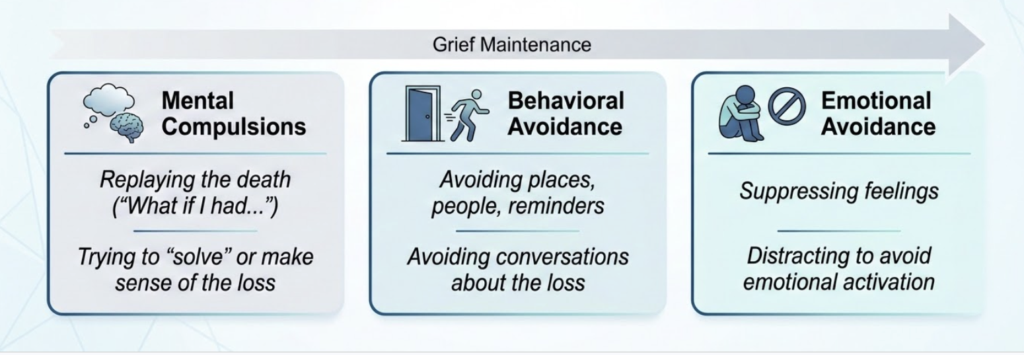
Mental compulsions
- Replaying the death (“What if I had…”)
- Trying to “solve” or make sense of the loss
Behavioral avoidance
- Avoiding places, people, reminders
- Avoiding conversations about the loss
Emotional avoidance
- Suppressing feelings
- Distracting to avoid emotional activation
Clinging/ritualized behaviors
- Maintaining belongings in rigid ways
- Feeling unable to tolerate any “letting go”
CBT Conceptualization of PGD
PGD can be understood using a familiar CBT cycle:
- Trigger: reminder, memory, quiet moment
- Thought: guilt, responsibility, or fear of “losing” the person
- Behavior: reviewing, avoidance, withdrawal
- Short-term effect: relief, sense of connection
- Long-term effect: grief remains acute and unresolved

Case Example
Maria, 42, lost her husband 18 months ago
Presenting concern:
“I just can’t move on.”
Assessment reveals:
- Hours of nightly mental replay of the death
- Avoidance of hospital and shared locations
- Withdrawal from social life
- Strong belief: “If I stop thinking about him, I’m losing him”
Clinical formulation:
Maria is engaging in mental reviewing (compulsion) and situational avoidance, which maintain her grief intensity and prevent integration.
Treatment Model: CBT for PGD
General frame
- 12–20 sessions
- CBT + exposure-based approach
- Can integrate elements of Complicated Grief Therapy (Shear)
Phase 1: Psychoeducation and Case Framing
Goals:
- Normalize grief
- Differentiate grief from stuck patterns
Key message for clients:
“It’s not your grief that’s the problem—it’s the patterns your brain is using to cope with it.”
Interventions:
- Map the grief cycle
- Identify short-term relief vs long-term cost
Phase 2: Identify Compulsions and Avoidance
Goals:
- Build awareness of maintaining behaviors
Tools:
- Self-monitoring
- Labeling patterns (e.g., “reviewing loop,” “avoidance pattern”)
Phase 3: Reduce Mental Reviewing
Goals:
- Decrease rumination and counterfactual thinking
Interventions:
- Notice and name reviewing
- Shift attention intentionally
- Response prevention: choosing not to engage
Clinical frame:
“The urge to figure it out is the trap—not the solution.”
Phase 4: Exposure to Grief Triggers
Goals:
- Facilitate emotional processing
- Reduce avoidance
Examples:
- Visiting avoided locations
- Looking at photos intentionally
- Talking through the loss in narrative form
Important distinction:
This is intentional, supported approach, not uncontrolled flooding.
Phase 5: Reconnection and Behavioral Activation
Goals:
- Re-engage in life
- Restore meaning and function
Interventions:
- Gradual return to activities
- Values clarification
- Building new routines
Frame:
“You can carry the loss and still move toward life.”
Phase 6: Cognitive Work
Common beliefs:
- “If I move forward, I’m leaving them behind”
- “I should have prevented this”
- “This level of pain proves my love”
Interventions:
- Cognitive restructuring
- Behavioral experiments
Phase 7: Integration
Goals:
- Shift from acute to integrated grief
Focus:
- Flexible, ongoing connection to the loved one
- Capacity for both sadness and engagement
Diagnosing Prolonged Grief Disorder
Red flags for PGD maintenance patterns:
- “I can’t stop thinking about what happened”
- “I avoid anything that reminds me”
- “If I stop, it means I don’t care”
- “My life is basically on pause”
Translate internally to:
This may be a compulsion/avoidance loop, not just grief.
Clinical Takeaways
- Grief itself is not the problem
- Stuck grief is often maintained by learned coping patterns
- These patterns closely mirror what you see in:
- OCD
- Depression (rumination/withdrawal)
- PTSD (avoidance/re-experiencing)
Bottom Line for Clinicians
Respect grief.
Do not rush it or pathologize it.
But when grief becomes:
- Rigid
- Repetitive
- Functionally impairing
Shift your stance from supportive presence to active, structured intervention.
That shift is what helps clients move from being stuck in grief to moving through it.
