“What if I lose control and hurt my child?”
“What if I snap and stab someone?”
“What if I secretly want to hurt someone?”
“What if having this thought means I’m dangerous?”
For someone struggling with Harm OCD, these thoughts can feel terrifying.
And then comes the second wave of fear:
Why would I even have that thought? What does it say about me? What if it means something?
This is where OCD gets sticky.
Harm OCD is a form of obsessive-compulsive disorder in which a person becomes intensely preoccupied with the possibility that they could intentionally or accidentally harm someone else—or sometimes themselves.
The thoughts may involve people the person loves most: a child, spouse, parent, student, patient, friend, or even a pet. They may take the form of words, images, impulses, sensations, or endless “what if?” questions.
And because the content feels so disturbing, people often assume the goal of treatment must be to make these thoughts go away.
It isn’t.
The path out of Harm OCD is learning that a thought does not require an investigation, an explanation, or an emergency response.
Step 1: See Through OCD’s Scare Tactics
OCD is incredibly skilled at identifying what matters to you—and then creating doubt around it.
If you care deeply about being a loving parent, OCD may ask:
“What if you lose control and hurt your child?”
If being a responsible teacher is important to you:
“What if you snap and hurt one of your students?”
If you value kindness:
“What if deep down you’re actually a violent person?”
This is one of the cruel ironies of OCD: the content of an obsession often targets the very things a person most values.
That does not mean every intrusive thought contains a secret message about your values. OCD would love for you to turn that idea into another puzzle to solve.
The larger point is simpler: OCD looks for material that will get your attention.
If a thought feels completely irrelevant, your brain can usually let it float by. But when a thought touches something deeply important—What if this says something terrible about me? What if someone I love isn’t safe?—your internal alarm system can light up.
And once the alarm goes off, OCD demands action.
Figure this out.
Make sure.
Check how you feel.
Review what happened.
Ask someone.
Google it.
Avoid anything that could possibly be dangerous.
Get certainty that you would NEVER do such a thing.
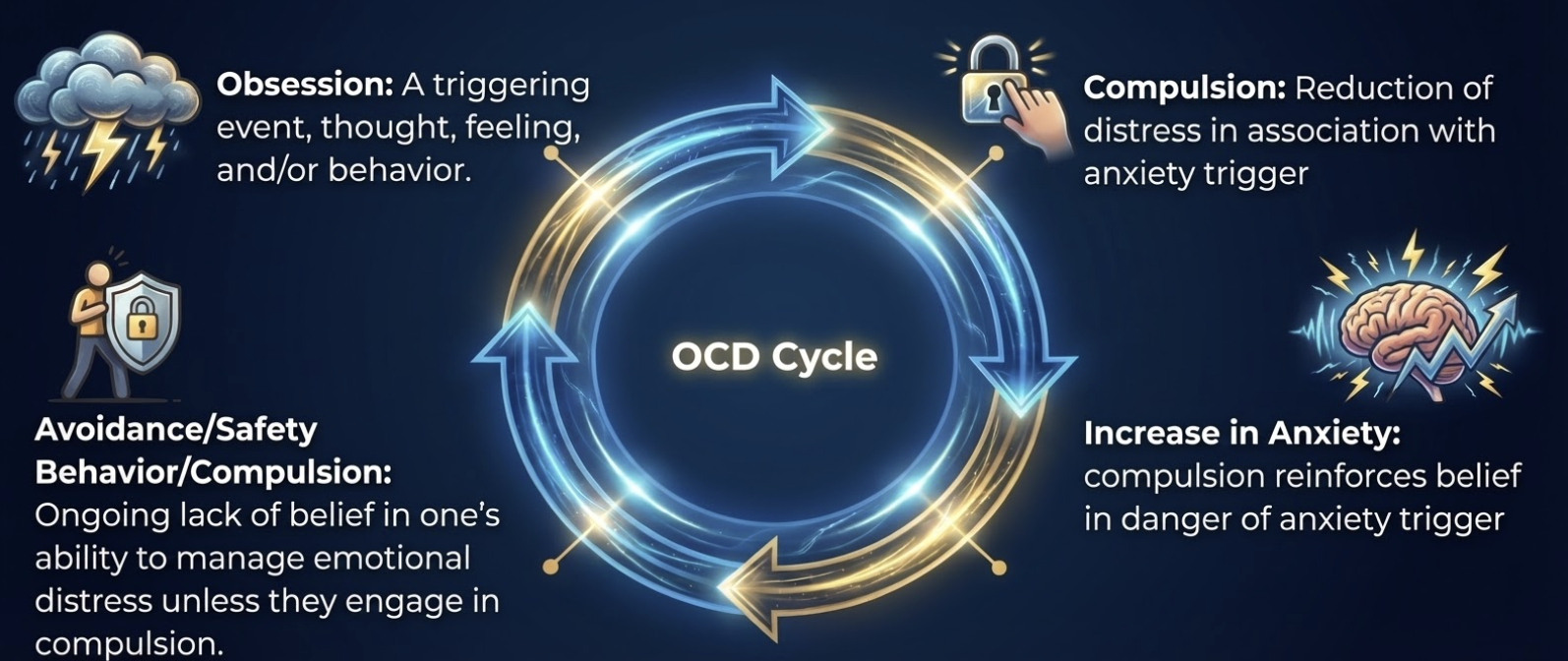
The problem is that every time you treat the thought like an emergency, you teach your brain:
Good catch. This thought WAS important. Please warn me about it again.
Intrusive Thoughts Aren’t the Problem. The OCD Cycle Is.
Human brains generate strange, random, inappropriate, violent, sexual, upsetting, and downright bizarre thoughts.
Having a thought is not the same thing as wanting it, endorsing it, or acting on it.
But OCD has trouble leaving that distinction alone.
Instead, it asks:
“But how can you be 100% certain?”
And that question can launch hours of mental detective work.
You may start reviewing:
Did I enjoy that thought?
Did I feel something when I had it?
Why did that image pop into my head?
Would a good person ever think this?
Have I ever lost control before?
What if this time is different?
What if this isn’t OCD?
You may also start monitoring your body for evidence—checking whether you feel anxious enough, disgusted enough, loving enough, or “normal” enough.
Or you may avoid knives, balconies, driving, being alone with your children, watching the news, holding a baby, or anything else your brain has labeled potentially dangerous.
These strategies can provide a moment of relief.
Unfortunately, that relief is precisely what can keep OCD going.
The brain learns:
Scary thought → danger → compulsion → relief.
And the next time the thought appears, the urge to perform the compulsion becomes even stronger.
Stop Trying to Solve the Thought
One of the hardest parts of recovering from Harm OCD is giving up the search for absolute certainty.
You may desperately want someone to tell you:
“No, you would never do that.”
“You’re definitely a good person.”
“That thought means absolutely nothing.”
“This is 100% OCD.”
Those statements may make you feel better for five minutes.
Then OCD comes back:
“But what if they’re wrong?”
And now you need reassurance again.
Treatment therefore isn’t about winning an argument with every scary thought. It’s about learning that you don’t have to participate in the argument.
OCD: What if you lose control and hurt someone?
You: Maybe, maybe not. I’m not solving that right now.
OCD: But shouldn’t you make sure?
You: I can handle not being completely sure.
And then you return your attention to the life you actually want to be living.
That is very different from convincing yourself that nothing bad could ever happen.
It is practicing the ability to live fully without obtaining impossible guarantees first.
Step 2: Use Exposure and Response Prevention to Retrain the Alarm System
Exposure and Response Prevention, or ERP, is a frontline behavioral treatment for OCD.
ERP involves gradually approaching the thoughts, situations, objects, images, or sensations that OCD has taught you to fear—while reducing the compulsions you normally use to feel safe or certain.
For Harm OCD, exposures are individualized and should be designed thoughtfully. They might involve gradually reducing avoidance of ordinary situations, saying or writing feared thoughts, reading triggering words, watching appropriate media, or practicing being around everyday objects that OCD has labeled dangerous.
But the exposure itself is only part of the work.
The other half is response prevention.
That means practicing not doing the things OCD demands afterward.
No Googling.
No asking your partner, “You don’t think I’d ever hurt anyone, right?”
No replaying the interaction for the 50th time.
No checking whether the thought “felt real.”
No scanning your emotions to make sure you’re appropriately horrified.
No mentally proving why you would never do it.
The goal of ERP isn’t to make anxiety disappear on command.
It’s to teach your brain:
I can experience uncertainty, discomfort, and scary thoughts without treating them as emergencies.
With practice, the brain gets better at sorting actual information from mental noise.
A Word of Caution About Reassurance—including This Blog
OCD is remarkably resourceful.
It can turn almost anything into a compulsion—including information about OCD.
You can read an article about Harm OCD and think:
Oh thank goodness. That’s exactly what I have.
And then 20 minutes later:
Wait. Was my thought slightly different from the example?
Did they say people with Harm OCD feel disgusted? Was I disgusted enough?
What if mine isn’t Harm OCD?
And suddenly you’re reading the article for the sixth time.
If you’re using this blog to repeatedly prove to yourself that you’re safe, good, or “definitely” experiencing OCD, notice what just happened.
OCD has recruited the article into the ritual.
You don’t need one more round of certainty.
You need practice moving forward without it.
Step 3: Get the Right Support
Harm OCD can be incredibly isolating because people are often ashamed or frightened to tell anyone what is happening inside their minds.
Many worry:
“If I tell someone what I’m thinking, they’ll think I’m dangerous.”
That can lead people to suffer silently for months or years.
Working with a clinician who understands OCD can make an enormous difference. A trained clinician knows how to assess intrusive thoughts carefully, distinguish OCD symptoms from actual safety concerns, identify subtle compulsions, and build an ERP plan that helps you reclaim the parts of your life OCD has taken over.
Good treatment also doesn’t become another source of endless reassurance.
The goal isn’t for your therapist to repeatedly tell you, “Don’t worry. You’d never do that.”
The goal is for your therapist to help you reach a place where you no longer need that sentence.
You Are More Than the Noise Your Brain Generates
Your brain produces thousands of thoughts.
Some are useful.
Some are boring.
Some are creative.
Some are ridiculous.
Some are disturbing.
And some arrive with an enormous burst of anxiety that makes them feel incredibly important.
But intensity isn’t the same thing as importance.
Recovery from Harm OCD isn’t about achieving a perfectly quiet mind.
It’s about changing your relationship with the noise.
Instead of asking:
“How can I make sure I never have this thought again?”
you can begin practicing a different question:
“Can I allow my brain to make some noise and still choose what I want to do next?”
That is where freedom from OCD lives.
Not in obtaining perfect certainty.
Not in finally finding the one argument that defeats every intrusive thought.
But in becoming increasingly willing to experience uncertainty—and continuing to live according to your values anyway.
Your thoughts don’t get to choose your life. Your actions do.